



The due diligence industry built its reporting workflow around what was easiest to deliver — not around what decision-makers actually need.
For decades, the process has worked the same way. You submit a request, investigators do the work, and a PDF lands in your inbox. You open it, skim through 50+ pages, and hope nothing important is buried on page 39 that a sleepy analyst skipped over. The format made sense when it was introduced. It just never kept pace with what the work actually demands.
And for most providers, that report tells you what they found. It does not tell you what they searched. Those are not the same thing.
What a PDF Can’t Tell You
Most providers document what they find. No one documents what they searched. That distinction is everything.
Even when a report tells you which jurisdictions were covered, it tells you almost nothing about how they were covered. Were upper and lower courts searched separately? Was the court accessed directly, or through a database that may not reflect current records? Were name variations and aliases run — and if so, which ones? Was a court runner deployed to counties where certain record types require in-person retrieval? For most reports, you will never know.
If a jurisdiction came back clean, there is no record it was run. If an alias was skipped, the report won’t tell you. If a court runner wasn’t dispatched where one was needed, that gap is invisible. What you receive looks complete because there is nothing in it to suggest otherwise.
If a search was run and never logged, did it actually happen? Your provider believes so. You have no way to verify it.
A clean report without an audit trail is not diligence. It is a document that says nothing went wrong and offers no way to prove it. For an industry that demands documentation and accountability at every other stage of a transaction, that standard is not good enough.
Selective Documentation is Not an Audit Trail
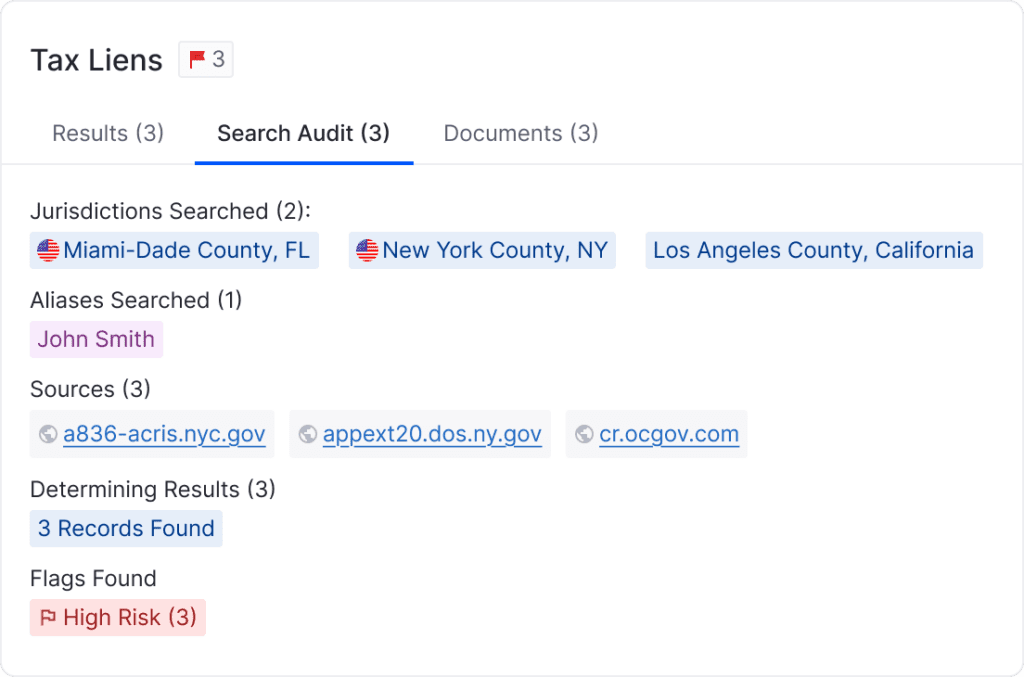
The search audit tab shows the full picture behind every finding: jurisdictions covered, aliases searched, sources reviewed, and determining results, all documented in one place.
Most providers add citations and footnotes when they find something worth referencing. That is selective documentation — it only tells you what was flagged, not what was searched.
At Vcheck, the process works differently from the moment an order is placed. Every investigation begins with a structured search checklist: a documented record of every search that needs to be run for that specific subject and scope. As investigators work through the case, every search is completed and documented against that checklist. Nothing is marked complete until it has been run. Nothing is submitted until QC has reviewed every single search.
The result is a verified record of everything that was searched — every jurisdiction covered, every alias checked, every source reviewed, whether it returned a result or not. That documentation is built into the investigation itself, not added after the fact when something needs to be cited.
The difference matters. The absence of a finding is only meaningful if you can prove the search was run.
Real-Time Visibility Changes How Decisions Get Made
The other problem with static reports is timing. A PDF arrives when the work is done — which means the client is entirely in the dark throughout the investigation. In high-stakes transactions, that information gap costs time and leverage.
A deal team waiting on a background check to clear is not just waiting on an email. They are waiting on visibility they should already have.
Real-time investigation tracking is a basic operational requirement for anyone managing a deal timeline. It allows for earlier conversations, faster escalation of material findings, and better timeline management. Live progress indicators, real-time court runner ETAs, and preliminary findings surfaced as they emerge should be the default — not a feature you have to ask for.
The Report Should Work for You
Static reports treat every reader the same way — same findings, same framework, same definition of what constitutes a risk — regardless of who’s reading it or what they’re actually deciding on.
Some providers will reorder findings by severity. What they won’t do is let you define what severity means for your firm. A bankruptcy filing that is disqualifying for one deal is background context for another. A litigation history that triggers a hard stop in one fund’s mandate is a footnote in another’s. The report you receive reflects a generic risk framework built for an average client — which may bear no resemblance to your actual thresholds.
And then there is the distribution problem. Once a PDF is sent, it gets forwarded and re-summarized, with key callouts buried in an endless email thread. That is not a workflow. That is a game of telephone with a nine-figure decision at the end of it.
Instead of an endless email chain, every stakeholder who needs access to an investigation or portions of the investigation can be added directly to the project. They see the same live results, download the same source files, follow the same message thread, and access invoices — all in one place. No forwarded attachments.
Customizable risk thresholds, filterable findings, and shared access for everyone who needs to be in the room — that should be the standard, not a workaround you build yourself.
The Investigators Haven’t Changed. The Transparency Has.
The investigations behind every report are still conducted by professional investigators with deep expertise across jurisdictions, languages, and source types. That foundation does not change.
What changes is the visibility you have into that work — not just the findings, but the sources, the documents, the search history, and the audit trail behind every result.
For the first time, clients can see exactly what was done, how it was done, and have documented proof that it was done comprehensively. What you get now is not just a better report. It is a clearer picture of exactly what you are deciding on — and the confidence that nothing was missed.
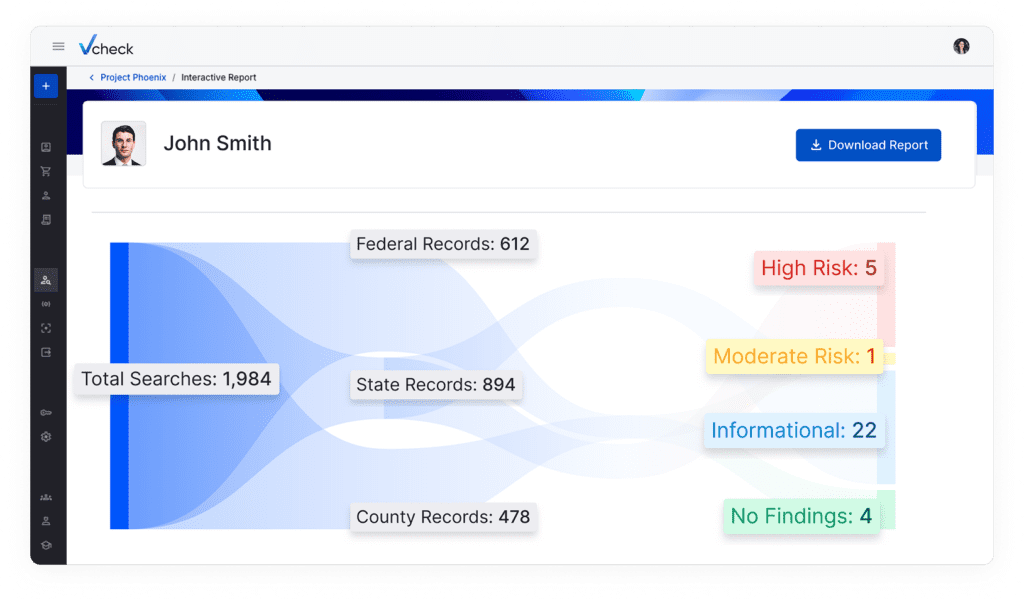
Full transparency across every stage of the investigation.